Tattoos in the workplace
DO YOU STILL NEED TO HIDE TATTOOS AND PIERCINGS FOR INTERVIEWS?
Ten years ago this definitely seemed to be the case with keen job seekers desperately removing piercings and covering up tattoos prior to an important interview. But today, in the world of work in 2017, is this still the case?
Surely we understand that judging potential candidates based on their appearance before their skills and attributes is the most primary example of ‘judging a book by it’s cover.’ In an age in which acceptance is key, why are we still suggesting that having a piercing/tattoo ‘gives the wrong impression?’ This is surely the exact kind of rhetoric we need to avoid in 2017. In a climate that supposedly praises individuality and self-expression, why does there still seem to be a taboo surrounding tattoos and piercings in the workplace?
The Answers
Deceiving as this heading may be… there aren’t any. Not definitively anyway. The frustrating thing about all those questions is that it’s hard to provide a definite answer to any of them. Policies on tattoos and piercings vary between companies, industries and individual workplaces so it can be hard to know whether or not your potential new employers will approve. According to the website ‘Support Tattoos and Piercings in the Workplace,’ 29% of people in the UK currently have a tattoo. This means that 29% of potential job seekers are facing the dilemma of whether or not to cover up before an interview. Although one can hope that mindsets have broadened and adapted enough to understand that one’s appearance is not reflective of their abilities, it appears that these perceptions are hard to shake.

Supporting tattoos and piercings in the workplace
The aforementioned website ‘Support Tattoos and Piercings in the Workplace,’ is quite clearly in favour of abolishing discrimination against those with piercings and tattoos. In fact, many companies now believe that not hiring someone because of their body art is archaic and reaffirms misguided prejudices. In his research into the place of tattoos in the hiring process, Andrew Timming at St Andrews University argued that ‘a change in attitudes is inevitable.‘ With celebrities bringing tattoos and piercings into mainstream culture and a lean towards a more liberal view on the matter, Timming argues that employers are going to have to accept that people with tattoos are integral to the fabric of society.
Against tattoos and piercings in the workplace
It’s always important to look at both sides of an argument. There are still plenty of employers to whom sporting a tattoo or piercing is not a trait of the desirable candidate. In fact, research conducted by Acas shows that some employers, including the manager of a removals firm and the regional director of an accounting firm, would still be reluctant to hire people with visible tattoos in case it put off clients and customers. The key argument against tattoos and piercings at work seems to be the concerns about the companies’ ‘image.’ It appears in many cases that employers are worried that hiring an individual with tattoos or piercings may put across the wrong impression to clients.

(Usher, 2017)
Should anti-tattoo discrimination be illegal? - www.bbc.co.uk

Tattoos are more popular than ever, but workers can be dismissed from or denied jobs because of their body modifications. Some want protection under employment law. Should they get it?
You're perfect for the job. You have all the skills and experience the company is looking for, and you've turned up for the interview in your smartest attire.
But there's a problem.
If you have a tattoo that incurs the displeasure of the boss, you might find any offer of employment is swiftly rescinded.
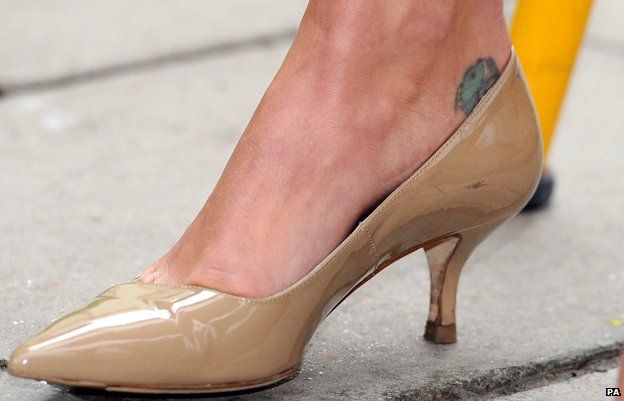
In July Jo Perkins, a consultant in Milton Keynes, had her contract terminated because a 4cm image of a butterfly on her foot contravened the no-visible-inking policy of the firm for which she worked. The company said she had failed to cover it up.
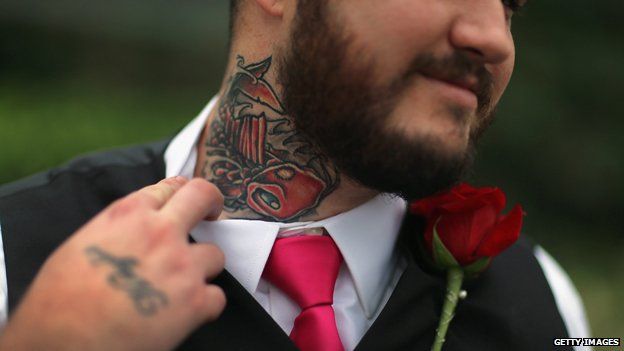
She wasn't the first. A 39-year-old mother-of-three from Yorkshire with the mantra "Everything happens for a reason" on her forearm was dismissed as a waitress in 2013 following complaints from customers. The previous year, a Next employee complained he had been forced from his job because his employers disliked his 80 tattoos.
In all cases, the employers insisted they were acting within their legal rights. And therein lies a potential hazard for a rapidly-growing section of the workforce.
One in five Britons now has a tattoo, according to research cited by the British Association of Dermatologists in 2012. Among US thirtysomethings the estimaterises to two-fifths.
From previous prime minister David cameron's wife, Samantha Cameron - who has a dolphin image on her ankle - to celebrities like David Beckham and Cheryl Cole, tattooed individuals are firmly part of the mainstream.
 PA
PA
But employers have not all kept pace with changes in attitudes. A report last year for the British Sociological Association found managers frequently expressed negative views about the image projected by noticeably tattooed staff.
While ink was an asset in some industries, such as those targeting young people, most of those interviewed felt there was a "stigma" attached to visible markings, according to Andrew Timming of St Andrews University, who carried out the study.
Words like "untidy", "repugnant" and "unsavoury" were all used to describe the perception clients were likely to gain of the organisation if someone decorated in this way was hired.
This was true even when managers were themselves fond of body modifications. "There were recruiters who had tattoos, who showed me them - they weren't visible on the hand, neck or face - they wouldn't have someone with a visible tattoo on display," says Timming.
Some enthusiasts for skin markings insist this is deeply unfair. A number of e-petitions have been organised against tattoo-related discrimination.
A 34-year-old from Birmingham who changed his name by deed poll to King of Ink (previously Mathew Whelan), who describes himself as the UK's most tattooed man, has led a campaign to protect the employment status of people with body modifications.
 BODY ART
Body Art (as he gives his shortened name), a property entrepreneur and Liberal Democrat activist in Birmingham, has personally lobbied ministers Lynne Featherstone, Jo Swinson and Ed Davey in favour of a level playing field for those with tattoos.
"If someone can do a job, they should be equal with the next person who has the same CV," he says.
Tattoos are more than simply a lifestyle choice, he argues - they are an expression of someone's identity just as much as their religion or other beliefs.
"I was nine when I knew I wanted them," he says. "People who are modified have an identity because of their image and who they are."
It's not a view that is widely shared by bosses.
Policies which restrict tattoos are commonplace in the UK. The Metropolitan Police bans them on the face, hands and above the collar line, as well as any which are "discriminatory, violent or intimidating". In 2012 the music retailer HMV was criticised for issuing guidelines instructing staff to cover up their ink. Airlines frequently place restrictions on tattoos among cabin crew.
 THINKSTOCK
Firms have every right to decide who represents them, argues independent human resources consultant Sandra Beale. An organisation that wishes to project a smart, professional image, or whose clients would likely be put off, is entitled to ban or limit body modifications, she says - workers can choose whether they prefer having a tattoo or a job.
 GETTY IMAGES
"For an employer, if they employ them in a customer-facing role, it could have an impact on reputation and doesn't portray a good corporate image," she says.
Around the world, the law tends not to protect tattooed employees.
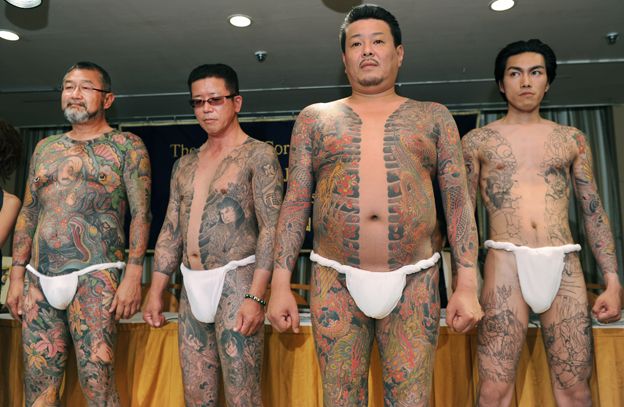
In Japan, where tattoos are widely associated with organised crime, bans are commonplace. A US federal appeals court ruled in 2006 that ordering public employees to cover up their tattoos did not violate their First Amendment rights. In New Zealand, where tattoos are an important part of Maori culture, a ban by the national airline on visible markings ignited a national debate.
However, in Victoria, Australia, they may be considered a physical feature protected by the Equal Opportunity Act 2010, according to at least one legal opinion.
Under UK law it's perfectly legal for managers to refuse to hire someone on this basis, according to employment law expert Helen Burgess, a partner at law firm Shoosmiths. The only exception might be under the 2010 Equality Act if the tattoo were connected to their religion or beliefs, she says - and even then a plaintiff would have to demonstrate this were the case.
Existing employees would fare little better if their boss took a dislike to a new adornment. "If there was a blanket ban on tattoos and an individual were to turn up with one, if the employer followed proper process that would be a fair dismissal in law," Burgess says.
By contrast, Body Art argues that body modification has "protected characteristic" status under the 2010 act, given the practice's connection to people's beliefs.

Japan's tattoo taboos
 GETTY IMAGES
- Tattooing in Japan goes at least as far back as 5,000 BC
- During 7th and 8th Century, evidence suggests that tattooing began to be used as a form of punishment for criminals
- Resulted in an enduring association with criminality, although elaborate tattoo artistry also has a long history
- Regularly linked to Japanese mafia - known as the Yakuza - whose members often sport tattoo "suits", invisible when fully clothed
- In 2012 the mayor of Osaka tried to crackdown on city workers with tattoos. "If they insist on having tattoos, they had better leave the city office and go to the private sector," he said at the time
- Young people tend to be more open to tattoos but still common for visible art to be banned in gyms, water parks and many workplaces
But the fact so many organisations have anti-tattoo policies suggests this interpretation of the law has not yet entered the mainstream among HR and legal circles. Secondary legislation specifically excluded tattoos and piercings from the 2010 act's definition of a severe disfigurement, on which basis an employer cannot discriminate.
For this reason, some tattoo artists refuse to ink the face, neck or hands of customers who are not already heavily inked.
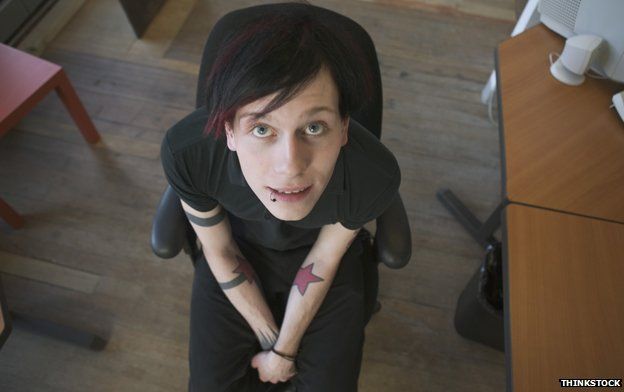
Nonetheless, the sheer critical mass of younger people with tattoos suggests it's likely that attitudes are likely to change over time regardless of what the law says.
 THINKSTOCK
Employers - especially those seeking specialist skills - may find they can't afford to exclude talent. In an effort to tackle a recruitment shortfall, the British Army is reported to be considering relaxing its rules to allow tattoos on the face, neck and hands.
However, says Timming, "There will be certain genres of tattoos that would never be normalised. Any kind of racist symbols would be a death sentence in terms of your job prospects."
Even now, he says, the size and location of a tattoo make a big difference to whether an employer is likely to accept it.
Likewise, designs with connotations of drugs, violence, crime or death are likely to impede a job search, Timming says. Even football-related tattoos sometimes cause applicants to be rejected because some employers associate them with hooliganism.
By contrast, "any kind of more innocuous, smaller tattoos - a rose or a butterfly - would be more acceptable in the workplace".
For the time being, it's advice worth considering when balancing the appeal of that new tattoo against the prospect of a dream job.
(BBC News, 2017)
I am going to create an online questionnaire and try to get as many people of all ages and backgrounds to fill it out. The questions will be based on tattoos in society and the aim is to try to get more information on what peoples perceptions of tattoos are.
From this survey i hope to get a better understanding of what people really think about tattoos. I have decided to do it through an online platform as i feel people will be a lot kore honest as they can speak their feeling without the fear of being judged. If inhere to ask these questions in person people might feel pressured into answering questions a certain way as i am tattooed. Also by making it anonymous people will again be a lot more truthful.
BIBLIOGRAPHY:
Usher, A. (2017). Do You Still Need To Hide Tattoos And Piercings For Interviews? - Career Advice & Expert Guidance | Fish4jobs. [online] Career Advice & Expert Guidance | Fish4jobs. Available at: https://www.fish4.co.uk/career-advice/still-need-hide-tattoos-piercings-interviews/
BBC News. (2017). Should anti-tattoo discrimination be illegal?. [online] Available at: http://www.bbc.co.uk/news/magazine-28758900

Comments
Post a Comment